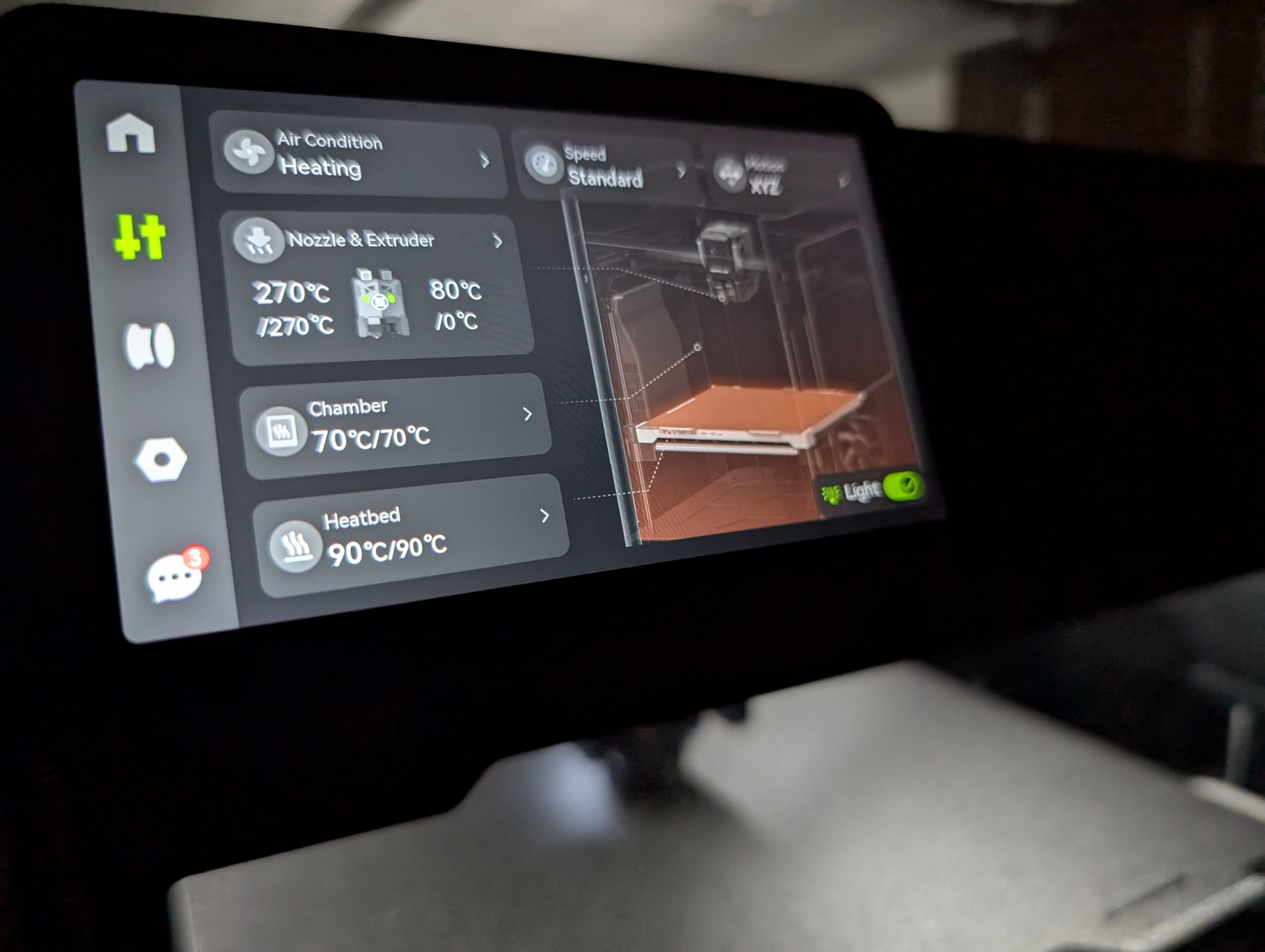
Although a small improvement, we recently discovered that there is a way to trick the machine to 70C. The trick is to set the temperature in your filament profile. Bambu Studio actually lets you set the temperature all the way up to 80C but will max out to 70C on the physical machine.
Read MoreIn the summer of 2024 we were approached by Tarn Greenlaw, a character modeler at Weta Fx who has worked on some pretty cool shows like The Guardians of the Galaxy, The Eternals, Thor, etc. He was working on converting a digital character designed by Youtuber J Hill to reality.
Working with Tarn and the Formlabs 3L, along with some great painting from Charron Props, we were able to bring this amazing piece of art to life.
Read MoreWe had the opportunity to use our Form 3L along with our Vaquform DT2 to create custom packaging for a designer who was making a limited edition run of resin 3D printed action figures.
Read MoreI thought it would be fun to 3D print my own bike saddle. Ever since Carbon partnered with Fizik, Selle Italia, and other brands, I've always wanted a 3D printed saddle but didn't want to shell out $600 for one. Although it's not exactly the same, it's amazing that I can now print my own saddle for less than $60.
Read MoreA local shoe designer needed some prototypes of their shoe outsole done in TPU. Because of the geometry, this part needed supports. Printing these supports in TPU would be a nightmare to remove...so we tried printing supports in PLA and it worked amazing 💪
Read MoreIf you have issues with your Bambu Lab X1C overhang quality, this is the solution. For the longest time our P1S outperformed our X1C when it came to PLA overhangs…turns out there was a change in the cooling fans at some point in production. Watch our video here to see all the details!
Read MoreThis post and video showcases a new trick we recently started using to ensure small, deep, blind holes always come out clean after the wash. No more clogs, trapped resin, or accidentally cured holes 🙌
Read MoreIn today’s post we share our findings on how much IPA can impact warping during post cure of SLA resin 3D prints and why it’s critical to dry parts more thoroughly than you think.
Read MoreWe’ve been running an extremely low cost, easy to use DIY heated chamber setup on our Bambulab X1C for around a year now with great success. The amount of warping on ABS, PC, and Nylon parts can be dramatically reduced by using a heated chamber.
Read MoreWatch our presentation on post processing, presented at the 2024 Formlabs User Summit!
Learn some useful tips & tricks to make post-processing suck less.
Read MoreIn the past we struggled with some build plates failing on Formlabs machines. The covers on the sides would pop out and no matter what you did they would continue to do so.
One of the things I love about engineering is being able to solve problems using First Principles. If we take apart a build plate and ask ourselves why this happens, we can come up with an explanation and solution.
Read MoreIn today’s post we want to share our findings on how flexible and elastic resins require significantly longer drying times than rigid resins in order to preserve dimensional accuracy.
Read MoreIn this blog we show how to build a cheap DIY fume hood in order to keep fumes from 3D printing at bay. This helps contain and filter VOCs and particulates generated with resin 3D printing and/or filament 3D printing.
Read MoreOver the past three months we’ve been printing production parts for a local medical device company as a stop gap until they got their injection mold tooling up and running. It’s pretty amazing to think that one can now rapidly scale up and do production using 3D printing in situations like this.
Read MoreFor the past three months we’ve been working on a new product. Funnily enough this wasn’t on our roadmap and was kind of an “accident” - but the amount of interest and traction led us to refine and release this next product.
For the first time ever, you can add your own logo and flair to a high quality, double sided, textured PEI plate or add your own pattern that will transfer onto parts.
Read MoreWe’ve been printing with Formlabs machines for many years now - starting from the Form 2, and now to the Form 3, Form 3B and Form 3L. These machines have been an integral part of our business and have allowed us to help hundreds of customers with their product development.
Knowing this, it’s no surprise that we have developed very specific processes internally in order to keep a tidy, clean and efficient workspace. In this post I want to share how we’ve been effortlessly removing parts from build plates. This is based on years of experience across every possible resin type, over thousands and thousands of parts.
Read MoreIt’s been around a year since we’ve launched our first product - the Camera Assisted XY Calibration Tool (or CXC for short). This is an optical tool which makes XY offset calibration on multi-extruder printers much easier, faster, and more accurate. Gone are the days of having to print annoying line patterns. In fact, our hate for the traditional line patterns is exactly why we developed the CXC for our Raise3D E2 before we brought it to life as a product for others.
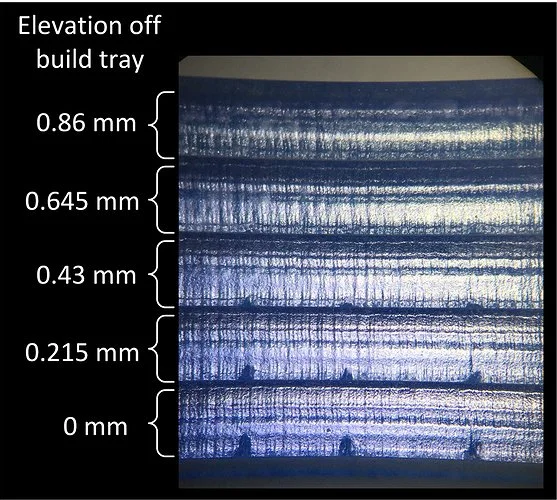
Read MoreLaser cutting sometimes induces artifacts on the bottom of your material due to reflection of the laser off the bed surface and back into the workpiece. This phenomenon is known colloquially as “flashback”.
While flashback isn’t a big deal during prototyping, it can be noticeable on production parts, or any part that needs to look more polished. It’s especially visible when laser cutting thicker clear acrylic.
However, there are simple ways to solve this. As seen below, flashback can be reduced or eliminated by elevating your workpiece above the work table.
Read MoreThere’s lots of talk these days about printing tooling for short run injection molding, or printing rigid molds for silicone casting.
One unique application is low volume, flexible 3D printed molds for rigid overmolding of electronics.
In this blog post we’ll cover how we used SLA 3D printing to make flexible molds that allowed us to overmold electronics for a polar bear tracker. This was a project done in collaboration with Mistywest and you can read about the project specifics here.
Read MoreOne of our thoughts and conclusions from the research was that flow plays a large factor in part strength and part defects resulting from high speed printing. This was confirmed empirically by Stefan (CNC Kitchen) in the video linked above. Flow can be affected by many factors, and one of them is filament. This is what we want to discuss today. Specifically - “flowability” of filament, also known as Melt Flow Index (MFI).
Read More